 The
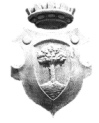
symbol of Novara di Sicilia is a walnut-tree. The coat of arms, which represents
it, is above many of the most ancient buildings and on the most beautiful
fountains of the village. Legend tells of an enormous walnut-tree in the
present piazza Matrice, where once a pagan temple was situated. The tree
was enormous and there was a spell on it. Every night the witches of the
district met on its branches to banquet with bread and eggs. To reach the
tree at midnight, each witch recited, "Ventu, forti ventu / portimi supra
a nuggià / di Spartiventu." Thus a window opened and a pig appeared
to take the witch on the walnut-tree to share in the nighttime banquet.
At the end, the pig accompanied each woman to her house.
However, none of them could ask
for salt: if they had done, they would have broken the spell and a violent
and furious wind would have dispersed the witches to the four corners of
the world. One night, one of the witches asked for salt and a violent wind
blew in and spread them around the world.
The millennial tree was demolished
when the Cathedral was erected and with its wood the closets, doors and
pews of the choir were built, which can still be admired in the Mother
Church. 
Nobody in Novara knows the origin
of this legend but everybody, young and old alike compete to keep alive
its memory and tell it to those people who come to the village, attracted
by its beauty and history.
The magic aura which surrounds Novara,
is one of the most atmospheric elements of this ancient village in the
province of Messina that developed a fundamental role through its strategic
position over the centuries, being at the center of the Ionian-Tyrrhenian
road system. Wayfarers and dealers, soldiers and monks who wanted to go
to Tauromenium and Naxos had to pass through here, and the same was true
for those who wanted to reach Tyndaris, Mylae (Milazzo), Longane (near
Rod“ Milici) and Abacena (Tripi).
 Novara
is a village of around two thousand inhabitants, set between the Peloritani
Mountains and the Nebrodi Mountains, in a valley protected, to the south
by the sharp massive structure of Fortress Salvatesta and Fortress Leone,
and to the north open towards the Tyrrhenian Sea. It dominates the whole
Mazzarrà torrent, which goes towards the sea, licking against Mount
Tripi,
over the slopes of which the powerful city of Abacena rose. On the left,
there is the Tindari promontory, on the right Cape Milazzo, while on the
horizon, when the air is clear, the Aeolian Islands contrast against the
blue sky and sea.
In past times, it was called Noa,
a word of Sican origin which means hay, thereby pointing out the agricultural
vocation of the area. With the Romans, it changed to Novalia (wheat field)
and for the Arabs it was Nouah (garden, flower). Noa rose at the feet of
Fortress Salvatesta, a natural rock that allowed easy control of the territory.
Diodoro Siculo, Cluverio and Fazzello wrote about it ("Super Junonia iuga
era antiquum oppidum Noae"). Its decline occurred because of the disastrous
earthquake in 365 BC, described by Paolo Diacono.
The Saracens moved into the inhabited
area of the valley, building a castle on a rocky spur on the St. George
torrent, of which we do not have very much left. After the Norman Conquest,
Lombard farmers who followed King Roger in the Sicilian expedition inhabited
Novara. Their presence had an important influence on the local traditions
and customs. Indeed, so much so that from the meeting of the two cultures,
a Gaelic-italic dialect formed, which is still spoken today in the nearby
hamlets, like Fondachelli and Fantina, detached from Novara in 1950. 
The road to Novara ascends following
the course of the Mazzarrà river, climbing steeply. The village
is set in a kind of natural amphitheatre of inexpressible beauty from which
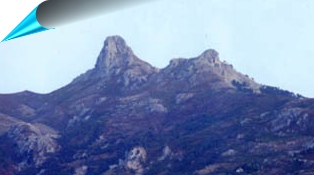
is notable the triangular outline of Fortress Salvatesta.
Novara is a special village as you
can see when you take the main road, Corso Nazionale, from where a dense
network of lanes departs, constituting the characteristic line of the village
together with churches and the chiselled artwork, which has made Novara
famous throughout Sicily. The first stop of our itinerary is in front of
the town building, the old oratorio of St. Phillip Neri, founded in 1610,
in front of which there is one of the most beautiful  fountains,
built in 1668 which was originally in the Greco district. A little further
we find the church of St. George, erected in the 12th century, which has
three aisles with twelve sandstone columns. From here, we continue along
via Bellini to scramble up the rocky spur on which there are the remains
of the Saracen castle, where you can also enjoy a magnificent panorama
of the village and of the valley of Mazzarrà. We are in the historical
nucleus of the inhabited area of Novara where the happy hand of sculptors
has left meaningful traces in the masks that overhang the entrances of
old abandoned residences, in the cagn˜ (which support the balconies and
have a dog shape) and in a magnificent seventeenth century fountain.
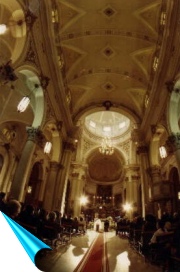
A little further on there is the Cathedral,
built like the other churches with local stone from local sources. Inside
it, there are valuable works like the "Assunta", a wooden statue by Filippo
Colicci (1767-69), the "Madonna with the Saints Anna and Venera", a painting
dated 1605 by Francis Cardillo, and "Going to Calvary" by Antonio Catalano
Senior (1598). In an alley near the Cathedral, there is the native house
of Sister Cristina of Jesus, a house with an evident Hispanic-Moorish style,
which attracts many visitors for its originality.
Crossing via Duomo, we reach Largo
Bertolami, the center of Novara, where there is a beautiful bronze David,
a work of one of the most famous local artists, Giuseppe Buemi, who made
it in 1882. On the right, there is the church dellÕAnnunziata, built
in the fifteen hundreds. It is currently closed for worship because of
the partial collapse of the roof. The "Annunciazione", a marble group of
1531by Giovanni Battista Mazzola, is kept inside it. Under the church,
there is another beautiful fountain of 1897, with the marble coat of arms
of the town.
If you take via La Marmora, you reach
the ex convent of the Cistercensi (today Orphanage Antoniano), with the
adjoining Abbey church which has a bronze sink of French art from the twelfth
century and a Hispanic-Moorish vase (giara of S. Ugo). 
Other churches that deserve a visit
is that of Saint Anthony the abbot built in the fifteenth century, set
in the low part of the village, under the rock of the castle. This is a
temple with three aisles, a characteristic portal of Norman style, whose
internal columns are constituted by a stone block and surmounted by capitals
equal among them.
Returning via Corso Nazionale, you
cross the Bridge of St. Sebastian to arrive after a few hundred meters
to a junction which leads to the hamlet of St. Basilio. A few kilometres
before arriving there, if you turn left towards Badiavecchia, you find
the ancient church of S. Maria la Noara, which belonged to the Cistercian
monastery whose work started in 1137. Windows and original doors with Gothic
arches are very characteristic.
As we return on the Main Road, we
reach St. Basilio, to the north of which there is the Shelter of Sperlinga,
the only example of a Mesolithic dwelling in Sicily along with the Corruggi
cave in Pachino. According to researchers, men used to find shelter here
from rain and bad weather or to rest after hunting. You need to ask the
Town hall to visit the shelter, as its entrance is closed by a gate.
If you return to State Road 185, you
reach Portella Pertusa (974 ms) first and then Portella Mandrazzi (1125
ms), from where a magnificent view of the valley of River Alcantara and
Mount Etna is enjoyable. From Portella Mandrazzi (at 27 km.) the fascinating
excursion to Fortress Salvatesta begins (better known as Fortress Novara).
With its 1340 meters, it is the second peak of Peloritani Mountains, of
which it is the most western outpost, if we exclude the mountains of the
Malabotta Wood. Over there are the Nebrodi Mountains.  Certainly,
when speaking about the Peloritani and the Nebrodi, but also about the
Madonie, it is not possible to establish a clean delimitation between them,
as they are a chain that from the province of Messina arrives up to the
gates of Palermo. It is different when one takes geomorphology into account,
as there are many differences between them. However, as a conventional
border between Peloritani and Nebrodi people generally indicate Portelle
Pertusa and Mandrazzi.
Spotting the Fortress of Novara is
easy, not only due to its triangular form (it is, in fact, indicated as
the Cervino of Sicily), but also because of its position, which allows
it to be seen from afar. This characteristic was useful to sailors, as
it was a reference point for ships, which ploughed the Tyrrhenian Sea.
A few hundred meters before the junction
snakes down to the Patrì river, we see the carrareccia which starts
on the left.
The road is on a constant slope: the
first part being in the middle of a dense wood of chestnut trees. Once
out of the wood, the road proceeds between rocks punctuated by rare vegetation.
On the right there is an amphitheatre delimited by pine woods. From Mandrazzi
the road  then
arrives at the Tre Fontane junction, where you cross the carrarecce that
come from Antillo and Francavilla di Sicilia.
This is a rare and fragile area because
of geological erosion: it is sufficient to think about the so-called "Ritagli
di Lecca", an imposing movement of indisputable charm, and the gigantic
coast crossed by a a deep fissure which impinges on the Patr“ valley.
The ascent toward the Fortress is
easy, even if at a certain point the path races among limestone rocks,
which seem carved by men. Spring is the best period to climb to the top
of the Fortress, because it is usually clear of clouds, but it is also
true that is worth covering your head to avoid unpleasant sunstroke.
Once on top you are overwhelmed by
a kind of dizziness and euphoria. It must be the height, or maybe the magnificent
panoramas showing the Aeolian islands, the Nebrodis, Mount Vernà,
stately Mount Etna, the valley Alcantara and Aspromonte.
 The
Fortress of Novara is one of those places where it is necessary to go in
order to understand and appreciate one of the numerous faces of Sicily,
its contradictory and variegated face, made of dense woods and stone deserts,
of deep valleys (dug in the mountains like scratches of a gigantic mole)
and alpine landscapes, of dry and dusty rivers and of plentiful falls.
But also of legends. Such as that
one which tells of the Salvatesta Fortress before the Trojan war, which
was inhabited by the Cyclops, who sheltered in Noa not only to escape the
devastation of Etna, but also to take off from the coast and avoid the
raids of people from Italy, Greece and the east who wanted to occupy Sicily.
Another
legend tells that "truvatura", a hidden treasure is hidden in the Fortress
Salvatesta. Old people from Novara say, in fact, that a brooding hen with
gold chicks is in the fortress and it is necessary for a woman to give
birth up there and sacrifice the newborn to get it. Another version tells
that a treasure big enough to satisfy the needs of the whole of Sicily
is contained in the Fortress. To get it, it is necessary to take linen
and make a napkin; then take some wheat, bring it to the mill, clean it
and mix the flour to make a "guastella" (pizza bread). Then, light a fire
with the firewood of seven different woods, cook the pizza bread, wind
it in the napkin and run to the Fortress. He, who reaches the top in 24
hours and breaks the pizza bread at the first strike of the bell of the
Cathedral, will get the treasure.
These curious legends and popular
customs bring us to the traditions that perpetuate during religious festivals,
that are numerous in Novara and every year attract crowds from nearby villages.
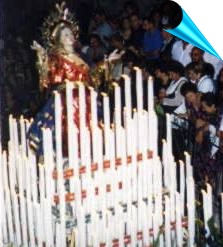
For example, there is the festival dell'Assunta, celebrated on August 15.
The cult was introduced by the Normans and up to the forties was held in
a form that made it the most spectacular parties of the whole province
of Messina, as the procession included 14 statues which had to pay homage,
through a consolidated ritual, the Assunta. Today the celebrations begin on July 31, when the statue of Assunta is brought "o so logu". The
artistic simulacrum is illuminated by over 140 candles, it weights around
a ton and is triumphally carried by over 30 men.
The day after the patron of Novara
S. Ugo Abate is honoured. His relics are carried in procession on an artistic
and historical wooden carriage of the eleventh century.
 The
Sunday following January 17, the festival of Saint Anthony Abate, shepherds
meet in front of the church devoted to him, to have their beasts blessed.
The festival is preceded by the "Settena", during which devotees light
candles. On the eve, then, a fire is lit at the base of the bell tower,
in order to be "shifted" from the so-called Fire of Saint Anthony. The
fire is lit with torches that each person brings. This visit to the saint
is called "u viaggiu."
The revocation of the Resurrection,
during Easter, is of great emotional impact. The statue of Christ Resurrected
is put in the so-called "Sphere." A rudimentary mechanism like a scale,
makes the statue of Christ jump from behind the greatest altar, launching
it aloft in a flash of lights, at midnight. The simultaneous opening of
the sepulchre on the altar completes the effect of the Resurrection, while
two doves fly from the sepulchre.
But if festivals are among the most
beautiful in Novara and province, it is at Carnival time that the streets
of the village are incredibly crowded with the famous tournament of Maiorchino,
a game that goes back to the first decades of the seventeenth century.
The curious competition consists in rolling a form of cheese Maiorchino
along a course that is over two kilometres long. The team (composed of
three players) which arrives first - "a sarva" - with the least number
of tosses, wins.
At the end of the competition, there
is the tasting of maiorchino and other typical cheeses of Novara, an occasion
for a first encounter with local gastronomy which has many tasty dishes.
The
good food lovers and those people who go around villages researching typical
traditional dishes and sweets who come to Novara can taste a dish of lempi
and trona (lightning and thunders), prepared with boiled and seasoned beans,
grass-pea, sweetcorn, lentils and wheat. Or pasta ncasciada, with veal
ragout, crumbled meatballs, aubergines, eggs and breadcrumbs. Pizzarr˜,
pipistuluritti, mullig˜, turt˜ and guastella are even more typical. The
cassatelli (filled with dried figs, honey, cinnamon and nuts), the rasuella
(decorated bread with nuts), the paummi made of biscuit of varied shape
and on which are set one or more coloured eggs, are also a must.
USEFUL
INFORMATION
From
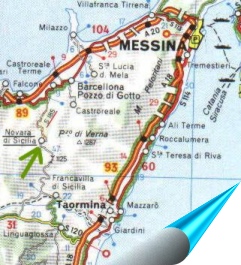
Messina or Palermo the motorway junction is that of Barcellona. You take
Main Road 113 towards Palermo, up to junction Salicà, where you
take Main Road 185 towards Mandrazze and arrive at Novara after 19 kilometres.
For those who come from the Ionian
side, instead, the junction to take from the motorway Messina-Catania is
Giardini-Naxos. Here the Main Road 185 begins, and it arrives at Novara
after 49 kilometres.
Where
to eat we suggest the restaurant - pizzeria La Pineta, via Nazionale,
145, tel. 0941 650522.
Accomodation: in Terme Vigliatore:
GRAND HOTEL TERME, Via Stabilimento tel. 090 9781792 - Belvedere, via Nazionale,
132, tel. 0909781339; Il Gabbiano, via Marchesana Marina, tel. 0909782343
- LA ROSA DEI VENTI Campogrande Tripi tel 0941 801020
Excursions
to the Shelter of Sperlinga: call the Town hall on 0941650954.
|
|
|
|